Used totes,
re-routed
before landfill.
IBC Illinois rescues 275 and 330 gallon intermediate bulk containers from the waste stream — pressure-tests them, regrades them, and sends them back into food, ag, brewing, and industry. Same tank. Second story.
Start a request — no phone tag required
Same form on every page. Once we have what's in the tote, where it's going, and how many you need, our yard team replies within one business day.
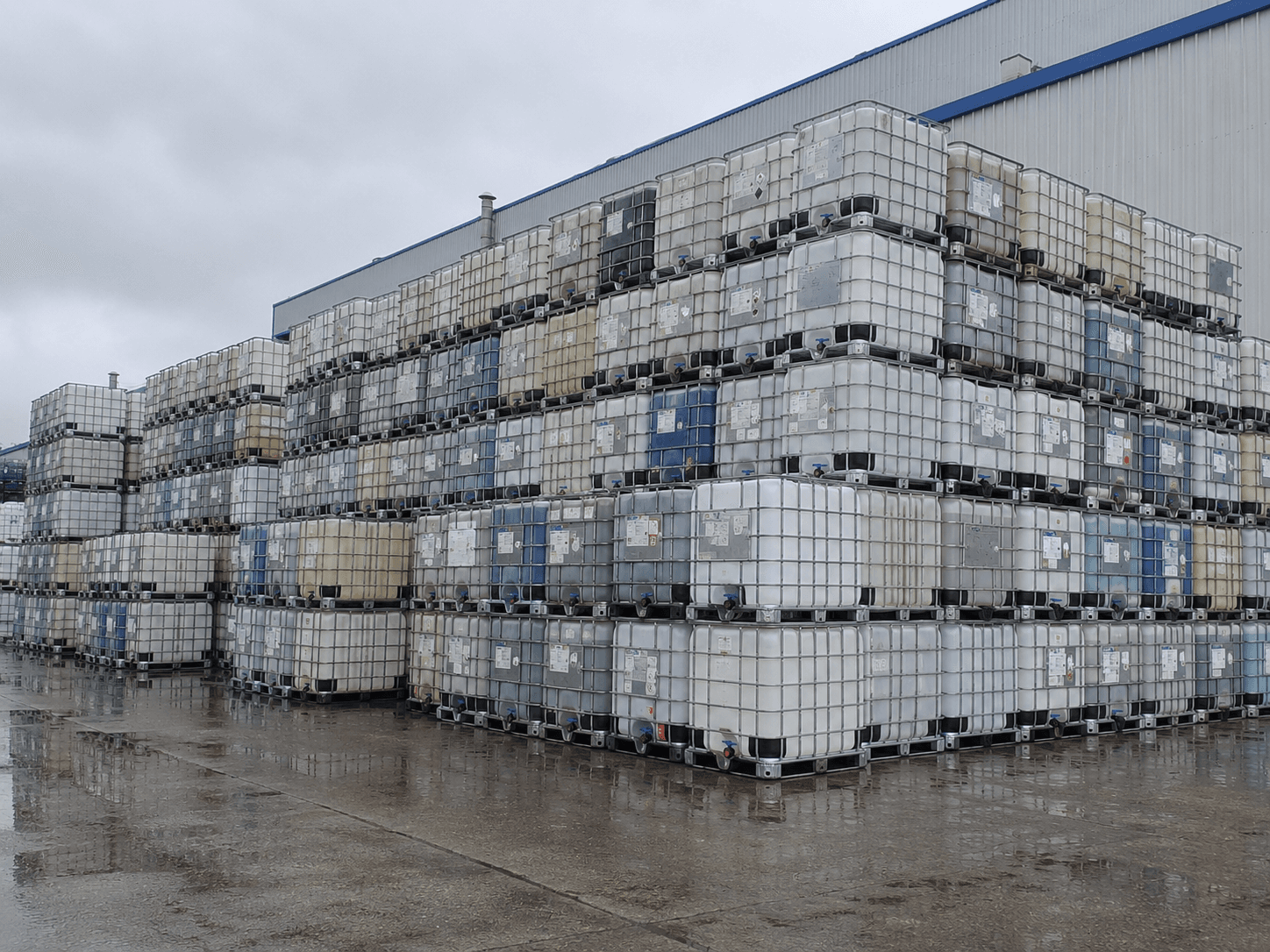
Four ways a tote moves through our yard.
We buy
Empty in your facility? We schedule a pickup or accept yard drop-offs. You're paid the day we inspect.
We buy your totes →We recondition
Hot-rinse, caustic wash, pressure check, and regrade. Every tote gets a chain-of-custody tag with the last known contents.
Reconditioning →We sell
Food-grade, clean industrial, light industrial, non-potable. One tote or a truckload of 80.
Browse stock →We repurpose
Rain catchers, hydroponic loops, hot-tub bases, mash tuns — custom builds out of totes we couldn't safely re-fill.
Custom builds →A new tote burns ~285 lbs of CO₂. We don't make new totes.
The HDPE in a typical 275-gallon IBC bottle takes around 144 lbs of crude oil feedstock to manufacture from scratch. That doesn't include the galvanized steel cage, the pallet, or the freight from a virgin-resin plant in the Gulf.
Most totes leaving service have years of use left. They get scrapped because they were inconvenient, not because they were broken. We exist to make the convenient choice and the green choice the same choice.
Buy a reconditioned tote from us instead of a new one and the math is brutal in our favor: roughly 96% less embodied carbon, 94% less embodied water, and 100% less plastic in a landfill.
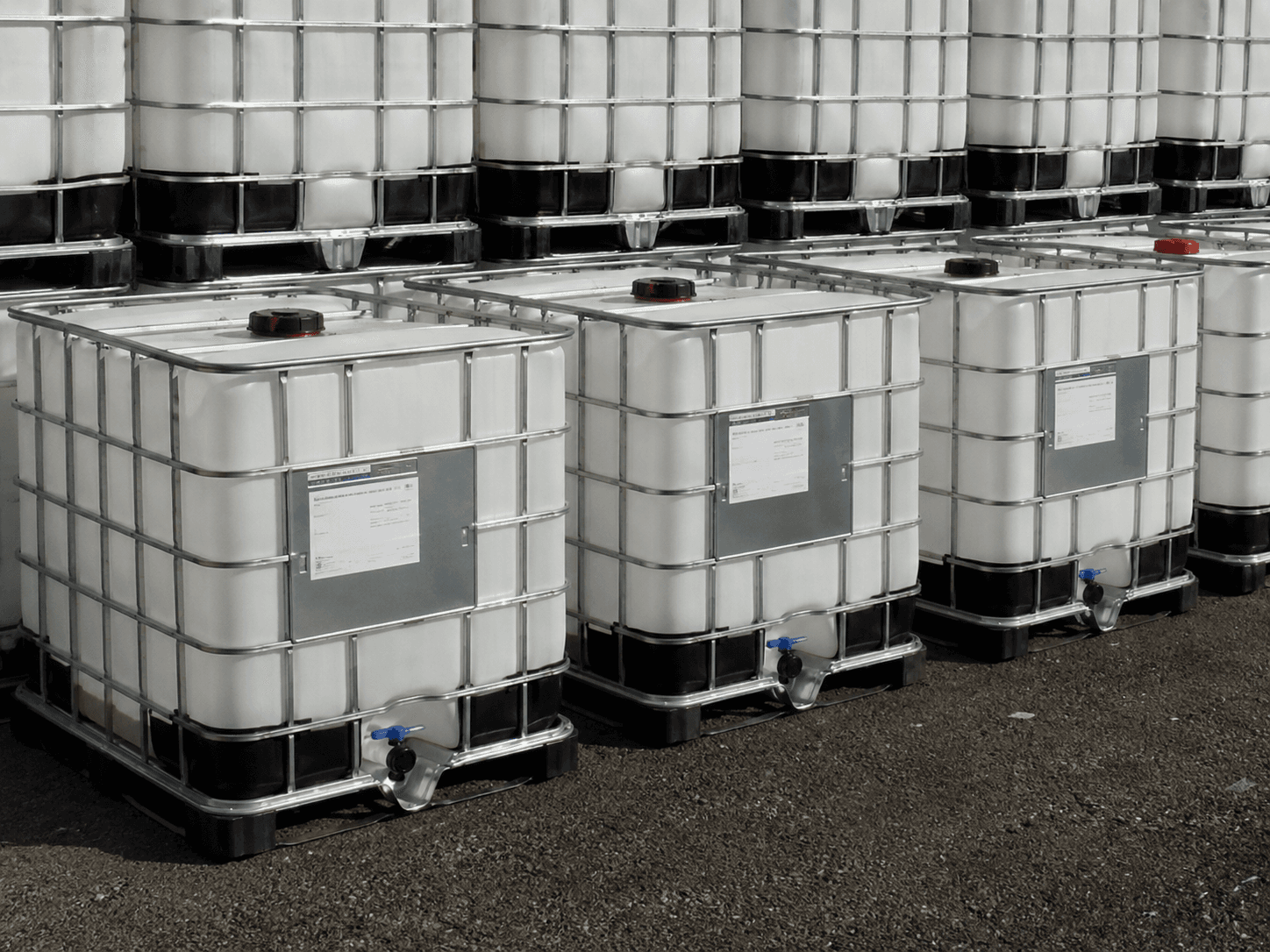
Real inventory. Not a catalog.
275 Gal Reconditioned Totes
Hot-caustic wash plus potable rinse, sealed cage, fresh gasket. Beverage, syrup, edible oil applications.
Read more →Grade B · Clean Ind.330 Gal Used IBCs
Empty from glycol, soaps, neutral industrial liquids. Pressure-tested, valves swapped if needed.
Read more →Grade D · Non-PotableCaged Tanks for Rain & Ag
Lower-grade tanks priced for outdoor water storage, livestock troughs, hydroponics, fire suppression.
Read more →AccessoriesValves, Adapters, Pumps
S60×6, S100×8 cam-locks, drum-faucets, transfer pumps. The thing that's holding up your job site.
Read more →CompositeStainless & Composite IBCs
When HDPE won't do — solvent storage, corrosive holds, high-temperature mash.
Read more →RepurposedTote Builds & Frames
Cut, capped, and welded. Garden caddies, rain barrels, hot-tub bases — ready to ship.
Read more →Started in a brewery's loading dock. Still proud of that.
IBC Illinois started in 2007 when two friends — one in industrial logistics, one in homebrewing — realized the brewery they bought hops from was stacking empty totes behind the building because nobody in the Midwest had a clean way to recycle them.
Eighteen years later we run a 4-acre yard on Scribner Ave in Grand Rapids, ship into 8 states, and have rescued well over a quarter-million tanks from the landfill.
Read the story →"Their Grade A totes shaved 11% off our packaging cost."
We use IBC Illinois reconditioned totes for unpasteurized cider holds. The chain-of-custody tags satisfied our copacker on the first audit.
— Production Lead, Hudsonville CideryRead the case study →"Pickup the same week. They cleared 22 totes off our pad."
We had eight months of empty soap and wax totes piling up. They handled the manifest, swapped them out, and we got a check on the spot.
— Owner, Detroit Detailing Co.Read the case study →Don't buy
another new tote.
Whatever you're storing, transferring, or growing — we almost certainly have a used tote ready for it on our yard right now.
Why the reuse loop matters more than the recycling loop.
There's a quiet myth in packaging sustainability that recycling is the answer. It isn't — at least not for IBC totes. Recycling an IBC means grinding 144 lb of HDPE into pellets, melting those pellets, and re-extruding them into something else. Every step burns energy and degrades the polymer. Reuse skips all of that.
When we wash a 275-gallon tote and resell it, we keep approximately 96% of the embodied carbon of a new tote out of the atmosphere. When a recycler grinds the same tote into pellets, the carbon recovery is closer to 41%. The math isn't subtle — reuse beats recycling by a factor of 2.3× on the embodied-carbon ledger for this specific container class.
What's stopping the wider adoption isn't engineering. It's logistics confidence. A buyer in Madison who needs a tote tomorrow can't wait for a reconditioner to find one. That's why we run the yard, the routing layer, and the consolidation network — to compress the gap between *I need a tote* and *I have a tote* down to the same week.
Our four-acre yard sits on a freight corridor that routes naturally into eight states. Our wash bays process 75–90 tanks a day at peak. Our consolidation routes mean a tank can move from your dock to ours and back to another buyer's facility in less than three weeks. That's the whole product.
Reused tote, recycled tote, new tote.
| Path | Embodied CO₂ | Embodied water | HDPE retained | Avg lifespan after sale | Per-unit cost (275 gal) |
|---|---|---|---|---|---|
| Reconditioned by us | ~12 lb | ~3 gal | 100% | 4 – 7 years | $89 – $185 |
| Recycled into pellets | ~170 lb | ~28 gal | ~62% | n/a (becomes new product) | n/a |
| Brand-new manufacture | ~285 lb | ~47 gal | 0% (virgin) | 5 – 8 years | $325 – $480 |
The operations behind the numbers.
Two wash bays. One fabrication corner. Three outbound dispatch days a week. Eleven people on the team. A drive-through gate that's open six days a week. A digital chain-of-custody system that goes back 24 months. A captured-drain wastewater system that routes caustic chemistry to a permitted industrial waste hauler — not into the storm drain, not onto the yard.
We don't have a sales team. We have a routing team, an ops team, and a fab team. Buyers email us, the email lands in our ops inbox, somebody answers it within a business day. There's no funnel, no CRM upsell sequence, no quarterly close push. We sell because we have inventory and the inventory is genuinely useful.
- 4-acre yard at 902 Scribner Ave NW, Grand Rapids — drive-through gate, indoor staging, two wash bays, fab corner.
- 14,800 tanks moved through the yard in 2024 (reconditioned, resold, or repurposed).
- 6-stage tri-stage process for Grade A food-contact totes — hot rinse, caustic wash, neutral rinse, potable polish, gasket replacement, chain-of-custody tag.
- 85% on-time delivery within Tier 1 (MI/IN/IL/OH/WI) measured against the date we quote, not the date the customer asks for.
- ~$11.85 average per-tank freight cost in 2024 — a 38% improvement over 2021, driven entirely by routing software and consolidation discipline.
If you only read one section.
- 01Used totes are the better default for almost any application below 158 °F that isn't pharmaceutical-grade. We can quote 92% of incoming requests against reconditioned stock.
- 02Grade is a workflow output, not a marketing label. We assign grade after wash, not before. Chain-of-custody documentation is what actually proves the grade.
- 03Freight is the silent killer of small reuse markets. Our consolidation network is the moat — typical per-tank LTL falls from $35 standalone to $12 routed.
- 04Sustainability and price point the same direction. A buyer who switches from new to reconditioned saves ~$200 per tank and ~273 lb CO₂ per tank. There's no trade-off.
- 05We're built to last, not built to flip. Family-owned since 2007, same two co-founders, same yard, same answer to every email within one business day.
Questions people ask us in the first email.
Is a reconditioned tote really safe for food contact?
How quickly can you deliver?
Why is there no phone number?
Do you buy as well as sell?
What's the smallest order you accept?
What if the tote arrives and it's not what I expected?
The words people use when they talk about IBCs.
- IBC
- Intermediate Bulk Container — the technical term for what most people call a 'tote.' Typically 275 or 330 gallons, HDPE bottle in a galvanized steel cage on a wood or plastic pallet.
- Tote
- Common name for an IBC. Used interchangeably.
- Grade A
- Industry shorthand for a tote that has been tri-stage washed, has a confirmed food-contact prior fill, and carries chain-of-custody documentation.
- Reconditioned
- A tote that has been formally washed and processed back to a specified grade. Not the same as 'cleaned.'
- Chain of custody
- A documented record of a tote's prior fill, wash process, gasket replacement, and grade assignment. The audit trail.
- Cam-lock
- A common 2-inch quick-connect fitting used on tote outlets. Also called type A/B/C/D camlock.
- S60×6
- A coarse Buttress thread used on many European-origin tote outlets. Requires an adapter to connect to most cam-lock plumbing.
- Tri-stage wash
- Hot rinse + caustic wash + neutral rinse, the minimum cycle for Grade A reconditioning. Often paired with a fourth potable polish stage.
- UN 31HA1/Y
- The UN certification stamp on a tote rated for hazmat fills. Y rating is the most permissive (medium-hazard liquids).
- Composite
- An IBC whose bottle is a steel inner shell with HDPE coating, rated for chemistries that permeate plain HDPE.
“The decision to buy a new tote is almost always a decision about logistics confidence, not about price or carbon. Our job is to make the confidence story believable enough that buyers stop reflexively reaching for new.”
— Mike Tarsis, co-founder